
Search

Scanner News and Know-how

The Expert Feed Scanner for Heritage Collections: the InoTec SCAMAX 6×1

Digitize cultural assets more productively and cost-effectively than ever before.

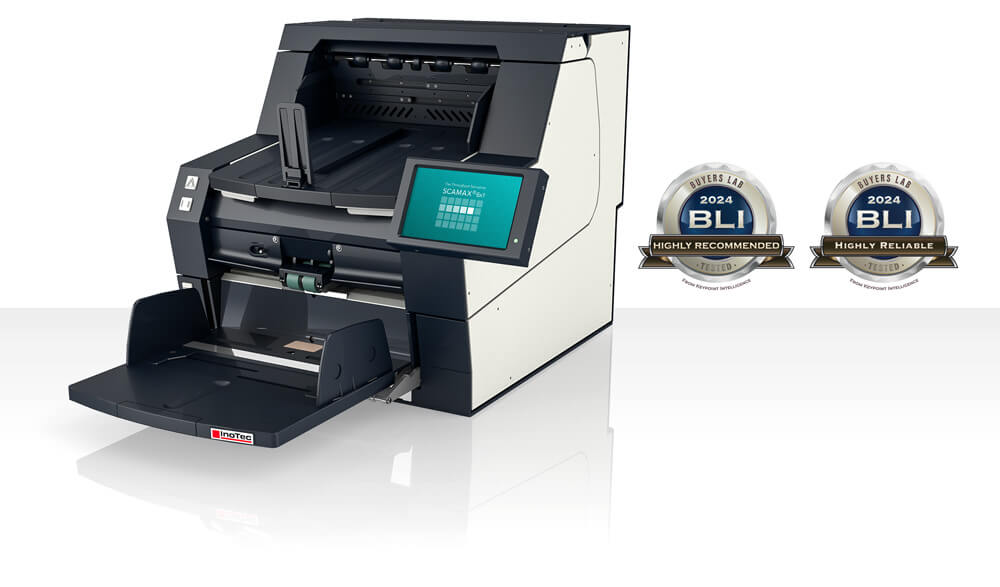
The SCAMAX® 6×1 digitizes fragile historical documents tens of times faster than any overhead scanner: secure, gentle on paper, and FADGI 3-star- and ISO 19264-1 (B)-compliant. The production scanner can be used as a stand-alone solution or as a hybrid solution when combined with over-head cultural heritage scanners from established manufacturers. This shortens your digitization projects by months, years and decades, and saves you six- and seven-figure personnel expenses in the process.

Historical records and fragile heritage items pose a particular challenge for document scanners.

Especially enhanced for the digitization of historical material

Gone are the days when old, sensitive types of paper from the heritage and cultural assets sector can only be digitized with slow overhead and book scanners, turning archive digitizations into never-ending projects! Now, for the first time, the SCAMAX® 6×1 is a productive feed scanner that has been specifically enhanced for the digitization of historical material and cultural assets. The SCAMAX® 6×1 gently digitizes loose historical documents tens of times faster than a overhead scanner.

This not only saves time, but also scanning staff. The heritage expert ‘Made in Germany’ is already being used in numerous successful installations worldwide as a stand-alone solution for archiving historical material. It can also be easily integrated into any existing scanning operation. This makes it ideal for use in hybrid scanning systems.

The challenges when scanning cultural assets:

  • Sensitive and fragile documents
  • Partially poor condition of documents (tears, creases and folds)
  • Soiling of the scanner due to dirty and dusty documents
  • Heterogeneous paper qualities and formats (books, newspapers, photos,
    index cards, loose documents, etc.)
  • Files with bound and loose archive material
  • Legal requirements for image quality (FADGI and ISO 19264-1)

The solution so far: Highest care. Use of overhead scanners. And time. A lot of time.

The solution today: the InoTec SCAMAX® 6×1 and hybrid scanning stations.

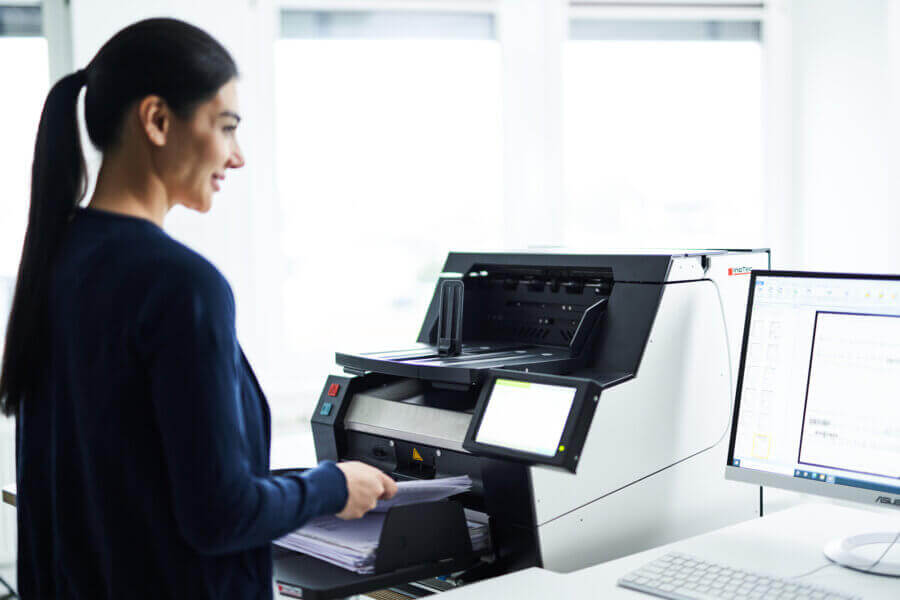
The InoTec SCAMAX 6x1 document scanner scans cultural assets safely, gently, and FADGI 3-Star compliant.

This is why the Inotec SCAMAX® 6×1 is your heritage expert

  • Belt transport system is gentle on documents
  • Large paper bending radius
  • Straight paper throughput for thicker or particularly fragile paper grades
  • Adjustable scan speed and SlowDown mode for delicate pages
  • Secure feeding of various document sizes in a single stack (from business card to A3 plus
  • Perfect image quality according to ISO 19264-1 (B) and FADGI 3-star standards
  • Hand-feed documents or stack them in the hopper for automatic feeding
  • Easy and tool-free cleaning
  • Compatible with all common overhead scanners and scan softwares
  • Can be quickly and easily integrated into existing solutions

The InoTec SCAMAX® 6×1 in the hybrid scanning station

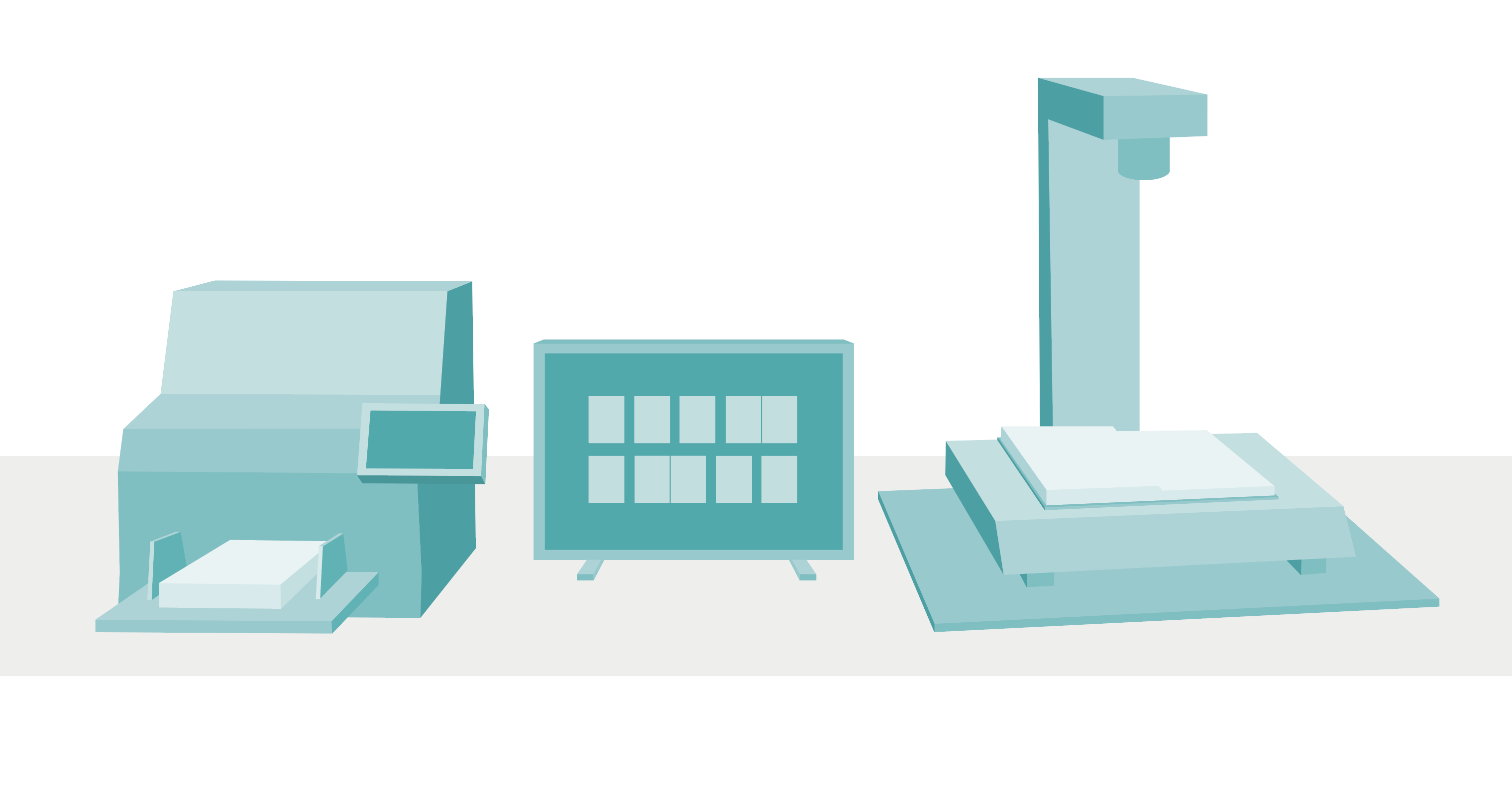
One feed scanner + one overhead scanner + one scanning software = incredible effciency!

Hybrid scanning systems with overhead scanners and feed scanners digitize sensitive cultural assets tens of times faster.

Often, collections contain loose as well as stapled or bound documents, all requiring different capture methods. In this case, a hybrid scanning station is the optimal and most resource-ecient solution. One scanning software serves as an interface for both scanners. All scans within a project are stored in the correct order, named consecutively, and can be exported together and fed into further workflows. Time-consuming merging of scans is eliminated, while productivity and user-friendliness increase enormously. Switching between scanners in a matter of seconds at the touch of a button.

The SCAMAX® 6×1 can be combined with any overhead scanner to form a hybrid scanning system and can be integrated into any existing scanning solution – regardless of software or manufacturer.

Example calculation: This is how much time (and personnel costs) a hybrid scanning solution can save you!

Assume an archiving project includes 5,000 files holding 300 sheets each. 95% of these are to be captured by a feed scanner.

Total processing time with an overhead scanner: approx. 11 years * 

Total processing time with a hybrid scan system (one overhead scanner and one SCAMAX® 6×1) and one scan operator: approx. 2.2 years **

* Assuming a processing time per sheet (front and back) of approx. 40 sec: 1,500,000 sheets x 40 sec = 60,000,000 sec = 2,778 person-days at 8 h/day = approx. 11 person-years at 240 days/year.

** Assuming a gross scanning speed of 60 sheets/min and 50% as a realistic net throughput, as well as 3 hours of effective scanning operation per scanner.

Users worldwide rely on the InoTec SCAMAX 6x1 for digitizing sensitive documents and cultural heritage.

Experience reports and user opinions: What users and customers say about scanning cultural assets with the InoTec SCAMAX® 6×1

“Our customer AL-AHRAM is the preferred archiving service provider of the Egyptian government. AL-AHRAM is highly satisfied with the SCAMAX® 6×1. Especially because the scanner also processes particularly light and sensitive paper types reliably and productively.”

Mahmoud Abd Allah, CEO of City for Trading & Contracting

“We used the SCAMAX in an on-site digitization project to scan nearly 40 million archival documents. The oldest documents dated from the late 1800s and were brittle and in poor condition. At first the client was concerned about further damage from using a document scanner. However it was quickly demonstrated that the InoTec was an ideal choice to gently capture materials in excellent quality while remaining cost effective for Crowley and the customer.”

Patrick Hill, Service Bureau Director, The Crowley Company

“When digitizing a national historical archive, The Crowley Company scanned millions of images from bound accession books, membership records, magazines, newsletters, and meeting minutes. Taking into account each material and its structural condition, our operators successfully combined a variety of archival quality scanners into a hybrid scanning system with the use of: planetary scanners for bound materials, microfilm scanners for high-speed microfilm capture and InoTec’s SCAMAX production scanners for loose materials. This approach extremely
accelerated the project and led to incredible results.”

Dave Westcott, Director of Imaging Services Sales and Contracts, The Crowley Company

You can download the flyer “The cultural heritage expert among feed scanners” as a PDF here.

Keywords:

Scroll to Top