



A conversation with Steffen Unmuth, Chief Commercial Officer at DATAWIN GmbH, published in the trade journal Krankenhaus-IT.

Krankenhaus-IT: Mr. Unmuth, why is choosing the right document scanner so important for hospitals?
Steffen Unmuth: The document scanner is the central tool for securely and quickly transferring paper-based health data into the electronic patient record (ePA). It’s not just about speed; consistent high image quality and smooth handling of different document types are crucial. If a device has weaknesses here, staff end up spending a lot of time on rework or error correction—effort that simply isn’t feasible in day-to-day hospital operations.
Krankenhaus-IT: What are the particular challenges in medical settings?
Unmuth: Hospitals don’t just scan standard letter/A4 pages. There are extra-long documents like ECG strips, small formats, handwritten notes, older thermal paper, or even X-rays. A scanner needs to process this variety reliably in mixed batches without constant manual sorting. That requires a sophisticated paper feeder and transport system.
Krankenhaus-IT: How important is user-friendliness?
Unmuth: It’s critical. Devices that are intuitive to operate reduce training effort and errors while boosting efficiency and user adoption. Clear menu navigation, automated scan profiles, and a well-structured status display are must-haves. Maintenance matters, too: feed rollers and other wear parts should be swappable in minutes without tools to avoid long workflow interruptions.
Krankenhaus-IT: What role does image quality play?
Unmuth: A major one. Scans must be razor-sharp, even with faded text or high-contrast originals. Comprehensive, on-board image optimization ensures text is automatically readable and images are rendered correctly—without staff intervention. That’s especially important when documents will be archived in a legally compliant manner or fed into Intelligent Document Processing (IDP) later on.
Krankenhaus-IT: And what about security and compliance?
Unmuth: Interfaces, drivers, and software should come from trusted sources—ideally from Germany. It’s also important that a scanner operates in compliance with TR-Resiscan to meet the legal requirements for the electronic patient record. And of course, sensitive and confidential patient data must never be cached locally on the scanner.
Krankenhaus-IT: Your bottom line?
Unmuth: Hospitals need scanners that reliably handle complex document batches, deliver excellent image quality, are easy to use and maintain, and perform well in any hardware and software environment. If you focus on these criteria, you establish the foundation for efficient, error-free digitization of patient records.
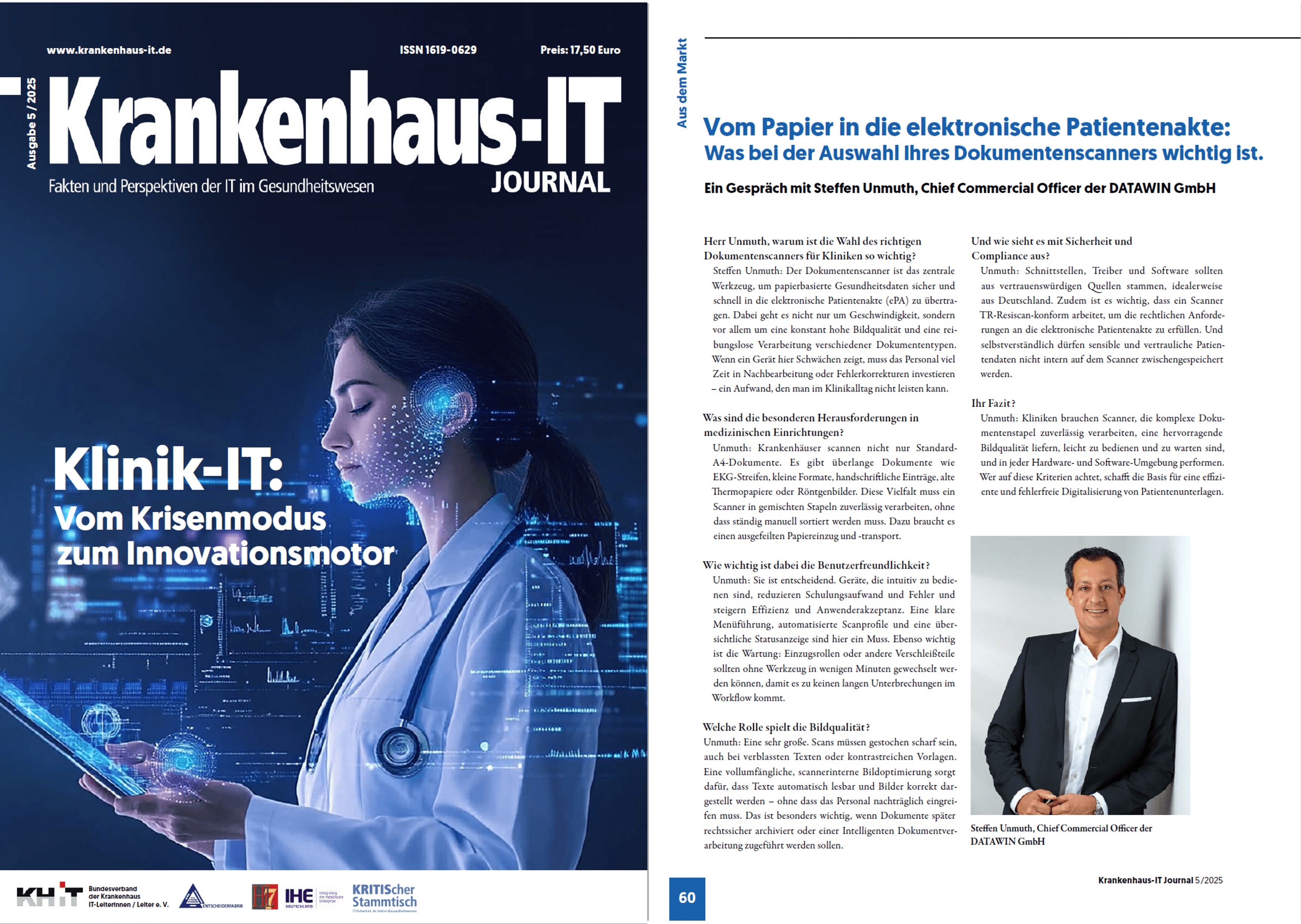
About Krankenhaus-IT:
The Krankenhaus-IT journal provides user-centric, practical coverage six times a year on developments and trends in information and communication technology, imaging, and process management for hospitals, clinics and MVZs (medical care centers) in Germany, Austria, and Switzerland.

Recent Comments